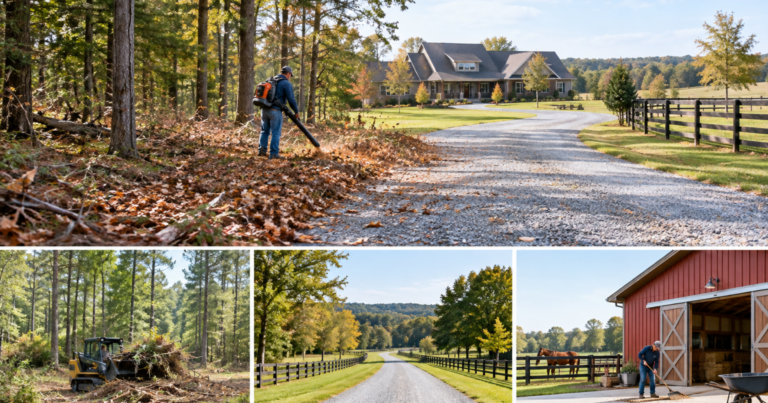
A one-acre wooded lot can bury a driveway in leaves, while five open acres may only need a tidy barn apron and clean thresholds. The right cleanup machine depends less on acreage and more on property workflow: where debris starts, where it needs to end up, how often you repeat the job, and what surfaces stand between those points.
Hazardous tree removal, utility-line debris, and heavy storm-damage work should be handled by qualified tree-care or utility professionals in compliance with local regulations and safety requirements.
In brief
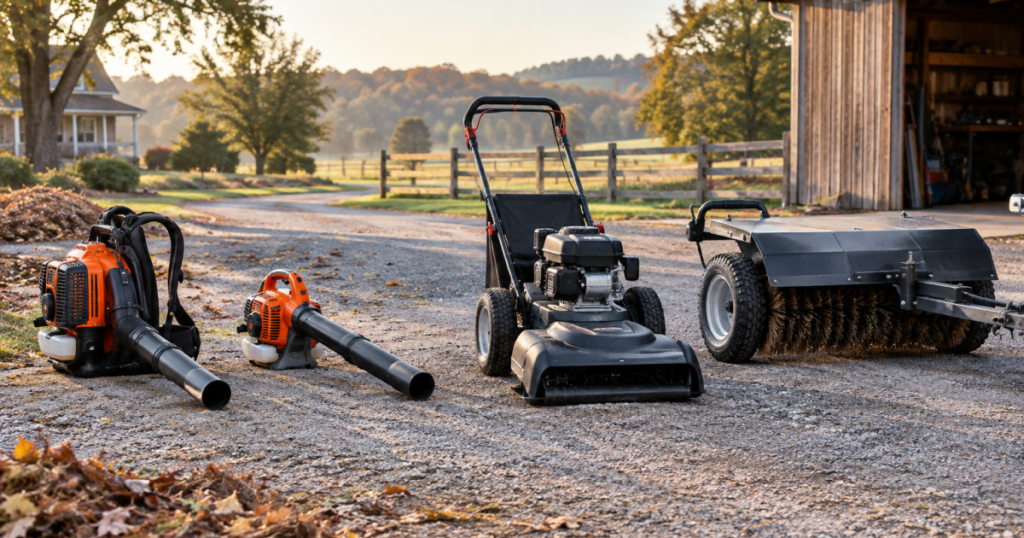
Choose by the job path first. A handheld blower is best for short, repeated touch-ups around doors, porches, trailers, equipment pads, and small hard surfaces. A backpack blower earns its place when you need sustained air movement across long drives, wooded edges, fence openings, and repeated fall sessions. A walk-behind blower suits broad open areas where you can push in clean lines. A tow-behind sweeper or vacuum setup makes sense when collection matters and you have room for a mower, ATV, UTV, or tractor to work without fighting trees, rocks, gates, and tight corners.
The mistake is treating acreage as the main sizing chart. Tree density, slope, surface type, debris destination, and operator fatigue can change the answer faster than another acre on the deed.
The scene that sorts the tools
Picture a property after a windy week: leaves drift across the gravel drive, needles stack against the shop door, oak leaves settle in the grass near the house, and dry chaff gathers around the barn threshold. One machine can move air, but it may not solve every part of that route. The driveway needs restraint so stone stays put. The shop apron needs dust control. The wooded edge needs reach. The lawn may need collection, mulching, or windrows instead of endless blowing.
That is where cleanup starts feeling less like “buy the biggest blower” and more like mapping a route. If you want visual examples of how routes, surfaces, and debris destinations change the job, the site’s illustrated cleanup transformations are a useful next stop.
Build the cleanup system around property workflow
A good cleanup setup answers four plain questions before it worries about brand, engine size, or headline output:
- Where does debris collect? House gutters, parking pads, low spots on gravel, barn doors, paddock gates, fencelines, wooded shoulders, and trail entrances all behave differently.
- Where should debris go? A compost area, leaf-mold pile, woods edge, burn pile where allowed, trailer, tarp, or collection hopper changes the tool choice.
- What surface are you protecting? Gravel, mulch, bare soil, mowed grass, concrete, and packed dirt need different air direction, throttle control, and cleanup methods.
- How long is the session? Ten-minute touch-ups favor light, handy tools. Two-hour fall resets favor comfort, fuel or battery planning, hearing protection, and less backtracking.
Once those answers are clear, the equipment categories separate quickly.
Handheld blowers: fast starts and tight spaces
Handheld blowers are the grab-and-go option. They are useful around porches, garage doors, feed rooms, trailers, small patios, steps, equipment pads, and the short stretch of drive that always catches leaves after a gust.
Their strength is convenience, not brute endurance. A compact cordless handheld such as the Makita XBU03Z 18V LXT Blower fits the kind of repeated cleanup many properties need between bigger sessions: clear the threshold, knock dust away from a workbench area, open the walkway, move clippings off a pad, then put it away.
The trade-off is operator fatigue and limited pushing power for deep, wet, or matted leaves. Handhelds can handle bigger tasks in pieces, but when you are making long passes down a drive or chasing leaves across rough ground, carrying the machine in one hand becomes the job.
Backpack blowers: sustained work over mixed ground
Backpack blowers make sense when cleanup runs beyond the house zone. Their value is not just higher air movement; it is carrying the load on your back while your arms steer the tube. That matters over long gravel drives, wooded shoulders, fence gaps, trails, ditches, and the long fall sessions where stopping every few minutes breaks the rhythm.
A gas backpack such as the Husqvarna 350BT is one recognizable example of the format, while other gas and cordless backpacks fill the same broad role in different ways. The important comparison is not only gas versus battery. It is whether your cleanup route has enough sustained work to justify the size, noise, storage, maintenance, fuel or charging plan, and protective gear.
Backpacks are strong candidates for wooded lots and long access lanes, but they still require judgment. On gravel, full throttle at the wrong nozzle angle can scatter stone. Near barns and shops, careless air direction can push dust indoors. In dry conditions, eye protection, hearing protection, and dust awareness are not optional details; they are part of finishing the job with energy left.
Walk-behind blowers: open lanes, fewer obstacles
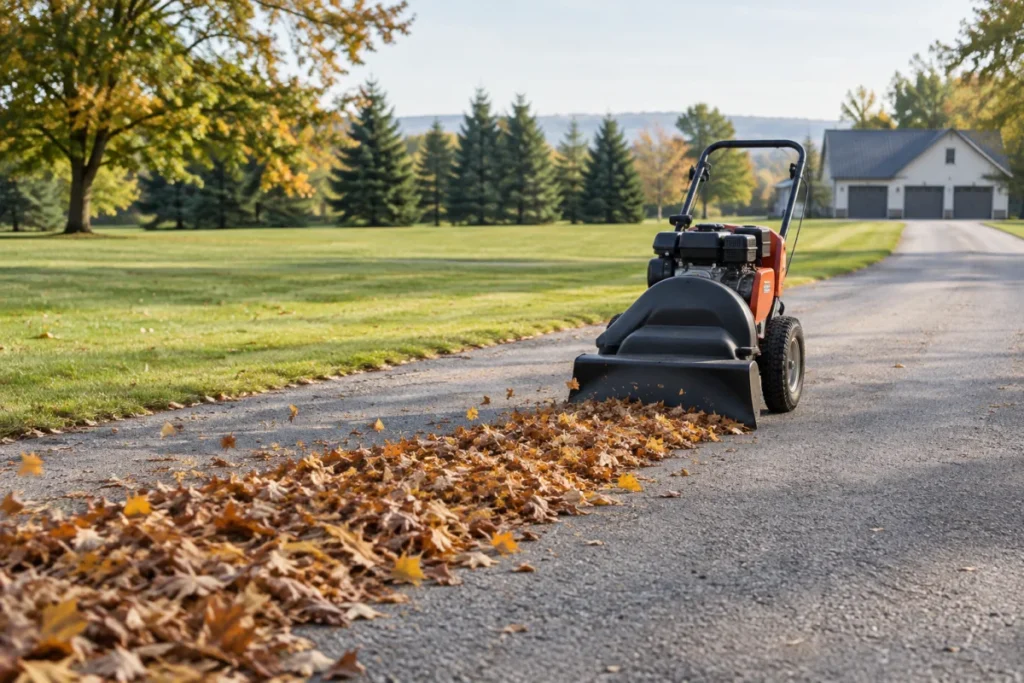
Walk-behind blowers shine where the path is wide and the debris can be pushed in a broad, controlled direction. Think long paved or packed drives, large parking areas, open lawns, and broad approaches to outbuildings. They can move a wide swath without wearing your shoulders the way a long handheld session can.
The catch is maneuverability. A walk-behind unit is less pleasant around saplings, rocks, exposed roots, gates, tight equipment rows, uneven ground, and narrow trails. If half the job is dodging obstacles, the wide machine may spend more time being repositioned than working.
They also need a destination. Pushing leaves across an open area is satisfying for about five minutes; after that, the pile needs somewhere to go. If the final destination is a woods edge, ditch line, compost bay, or tarp, plan the route so the blower is not simply building a pile you have to rebuild by hand.
Tow-behind sweepers and vacuums: collection, not just movement
Tow-behind tools solve a different problem: they collect or carry debris instead of only moving it. They fit properties with enough open, accessible ground for a mower, ATV, UTV, or small tractor to run predictable passes. If your main issue is a heavy leaf load on mowed acreage, a tow-behind sweeper can be more efficient than blowing everything into piles.
Access is the make-or-break factor. Slopes, tight turns, soft ground, exposed rocks, low branches, fences, and narrow gates can limit the real usefulness of tow-behind gear. Collection also means unloading, dumping, composting, or hauling. That is not a downside if your debris destination is set up well; it is a headache if you have not planned where each load will go.
A corded blower vacuum such as the Toro 51621 UltraPlus Leaf Blower Vacuum is a different category from tow-behind equipment, but it highlights the same principle: vacuum and mulching functions are most useful when the debris is dry enough, close enough, and small enough for the tool’s format. Collection tools reward realistic conditions.
Surface and debris rules that change the answer
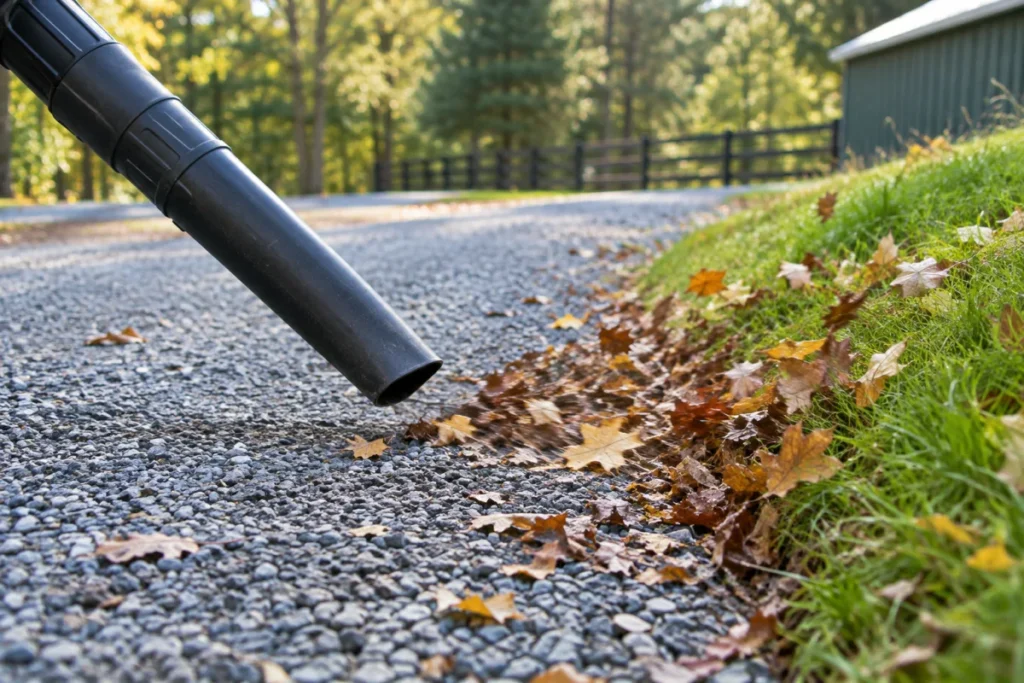
On acreage, the same tool can feel brilliant or frustrating depending on the ground under your boots.
- Gravel drives: Use controlled air, lower angles, and planned passes toward a shoulder or collection point. Bigger is not better if it throws aggregate into grass or ditches.
- Wooded lots: Backpack blowers often fit because the job is long, uneven, and obstacle-heavy. Preserve useful leaf litter where it protects soil or habitat, and clear the working zones that matter.
- Barns and shops: Handhelds are handy, but dust direction matters. Blow away from doors, feed areas, tools, and open storage.
- Open lawns: Walk-behind blowers or tow-behind sweepers can work well if the path is open and the debris destination is ready.
- Wet leaves: Expect slower work, heavier piles, and more passes. Sometimes waiting for partial drying saves effort unless drainage, access, or safety demands immediate clearing.
When one tool is not the system
Most larger properties are easier to manage with a small cleanup chain rather than a single heroic machine. A handheld blower handles the daily edges. A backpack clears the drive and wooded approach. A mower, cart, tarp, or sweeper moves volume once debris is gathered. Rakes still matter where precision beats air.
This is also where product research should stay honest. Manufacturer specifications are useful for comparing categories, but real results change with leaf depth, moisture, nozzle control, wind, terrain, and how far debris must travel. If you use retailer links while comparing tools, our affiliate disclosure explains how those links are handled.
Key questions answered
Is a backpack blower too much for a small acreage property?
Not if the work is long, dense, or repeated. A small wooded lot with a 300-foot drive can justify a backpack sooner than a larger open parcel with light debris. The better question is whether the machine reduces fatigue and backtracking enough to earn its storage, maintenance, and noise footprint.
Should gravel-drive cleanup use a blower or a sweeper?
Use a blower when you need to move leaves off the travel lane without collecting every bit of debris. Use a sweeper only where the surface and access allow it to work without scooping stone, bouncing over uneven ground, or forcing awkward turns. Throttle control and nozzle angle matter more than raw power on loose aggregate.
When does tow-behind equipment make sense?
Tow-behind equipment makes sense when the property has open turning room, repeatable passes, and a clear unloading destination. It is less convincing on tight wooded lots, steep slopes, narrow gates, and properties where most debris is trapped around buildings, rocks, trees, and fences.
What stands out
The best acreage cleanup choice is the one that fits the route. Start with the surface, debris volume, destination, session length, and machine access. Then choose the format that removes the most repeated labor without creating a second problem, such as scattered gravel, dust in the barn, piles in the wrong place, or a collection hopper with nowhere useful to dump.
For more acreage cleanup routines, equipment thinking, and seasonal problem-solving, browse the blog and keep building a system that matches the way your property actually works.